
Visual Navigation Systems
How a visual navigation system works
A grand opening is a wayfinding problem before it is a marketing problem. This is how we size, place and build a route — the same way we would explain it to you standing on the frontage.
Why signage underperforms at a grand opening
A monument sign is eight to twelve feet tall, it does not move, and it is read by people who are already looking for you. That is the right tool for a permanent address. It is the wrong tool for a Saturday.
The buyer you want on opening weekend is doing 45 on an arterial road, going somewhere else, and has no reason to scan the shoulder. Nothing at sign height enters their attention, because at that height it is competing with every other sign on the corridor. Sound walls, mature landscaping and grade changes finish the job — on most Inland Empire frontages the community is not visible from the road at all until you are past the turn.
Three things change that, and only one of them is available to print.
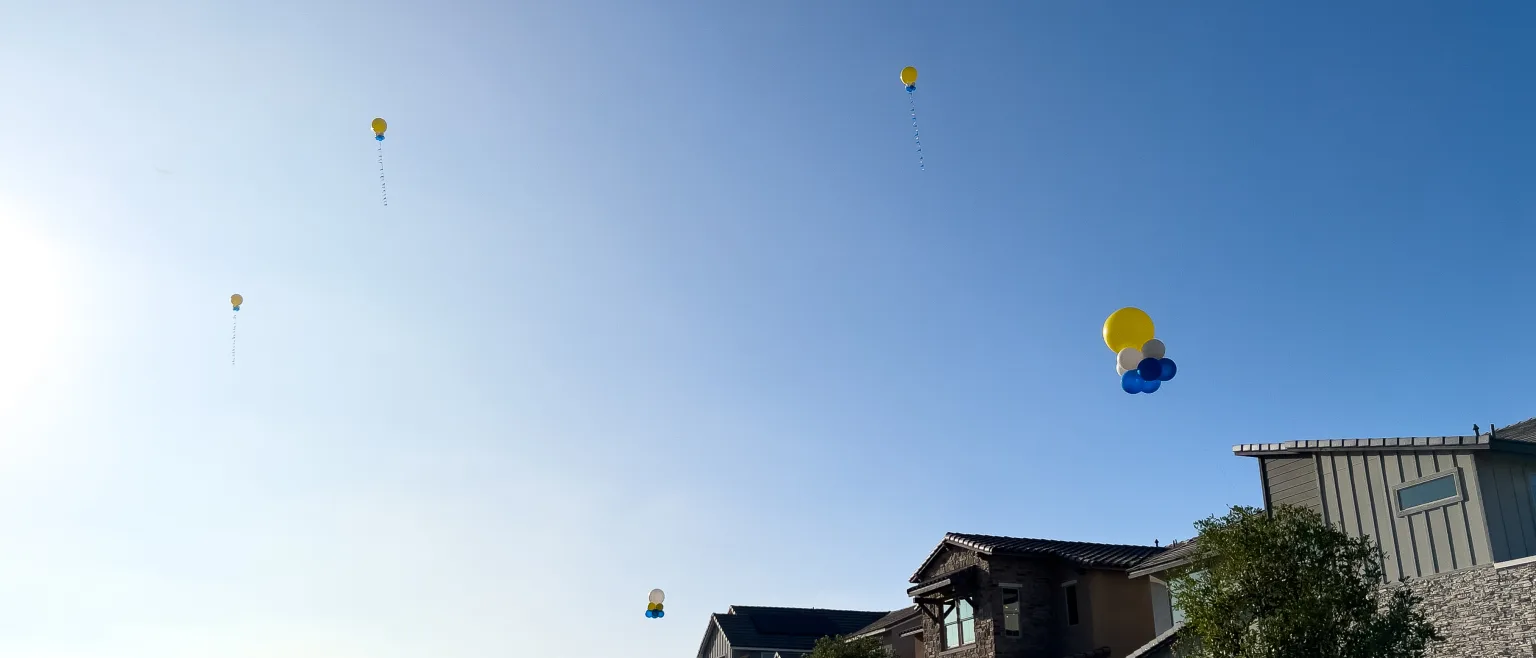
- Height. The destination anchor flies more than 100 feet up. That clears rooflines, sound walls and landscaping, and it is visible from the arterial before the driver reaches the turn.
- Motion. Ribbons and pennants move in wind. Peripheral vision detects motion involuntarily — a static sign competes for attention, a moving object takes it. This is the one thing permanent signage physically cannot do.
- Color. Saturated, matched to your brand using the closest available balloon color, at a scale print cannot hold outdoors.
The distinction worth holding on to: a sign answers “what is this” for someone who has already stopped. A navigation system answers “there is something over there” for someone who has not. Those are different jobs, and an opening needs the second one first.
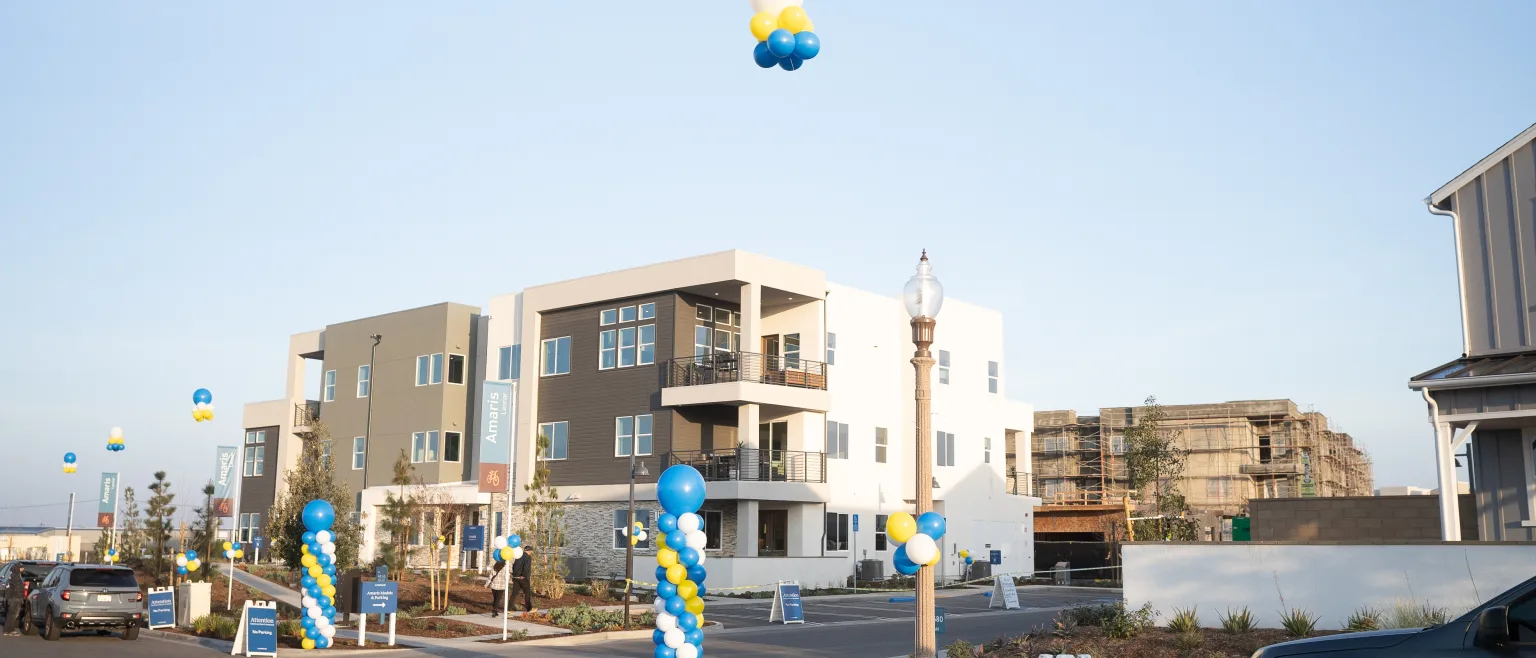
- Columns mark the entrance. Layered balloons on a base plate, finished with a giant topper, standing about as tall as the sign beside them.
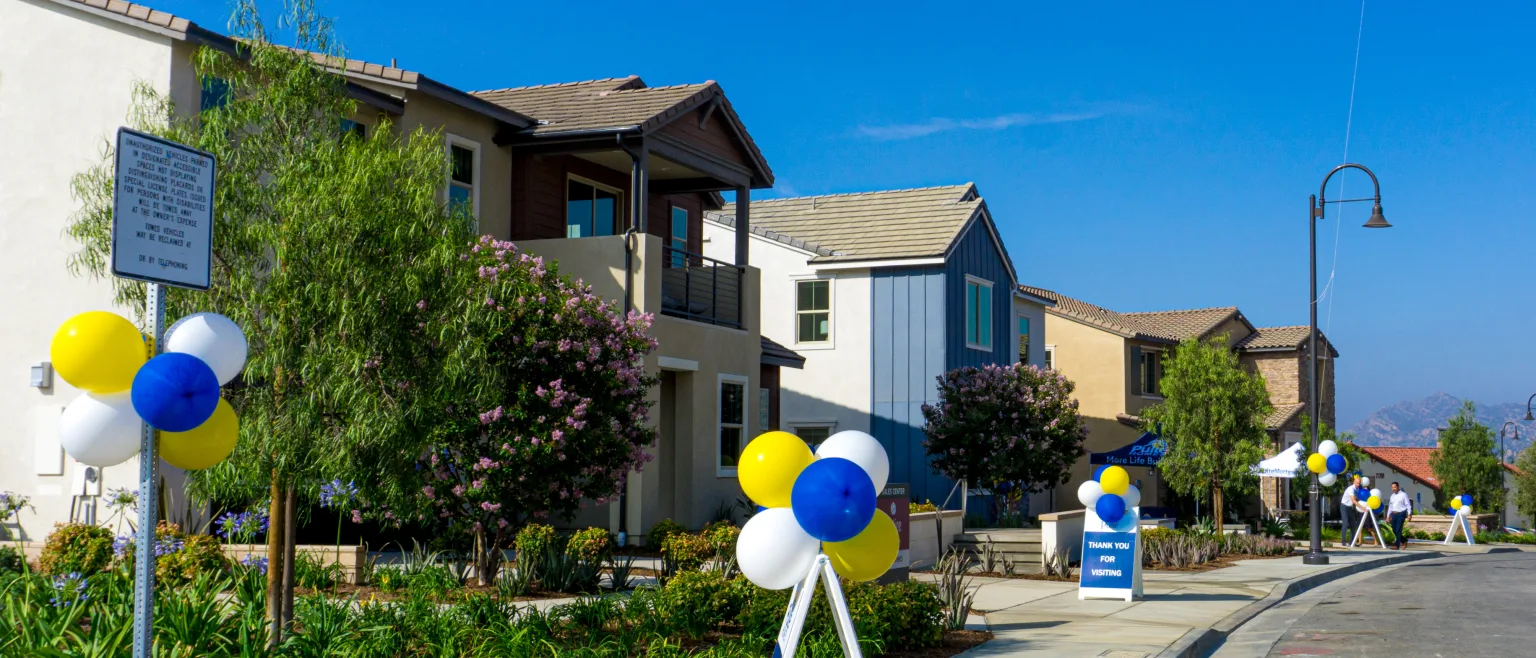
- Clusters are the path breadcrumbs. Six balloons on a 5 ft pole with ribbons, at the eye level of a driver already on the route.
- Helium mini columns are the route anchors. They fly on a tether at 15–16 ft, above the roofs of parked cars.
- The Deluxe 5ft Helium Highflier is the destination anchor. It flies more than 100 ft up, with pennants that move in the wind.
The three tiers, in operational detail
A route is built in three tiers, and they do different work at different distances. In practice the middle tier splits across two altitudes, which is why you will see four bands on a plan.
Tier one — the destination anchor
One element, flown above the model complex on pennants, more than 100 feet up. It is the only part of the system that works on a driver who is not looking for you, and it is the part that gets cut first when a budget is set by someone who has not stood on the road. It should be the last thing cut, not the first.
The anchor marks the destination, not the entrance. You are navigating people to a place; the anchor is where the place is.
Tier two — the route
Once a driver has committed to the turn, the anchor has done its job and is often behind them or out of sight. The route takes over. Helium route anchors fly at roughly 15–16 feet, high enough to hold a sightline over parked cars and construction fencing. Below them, path breadcrumbs sit at eye level at every point where the route could be misread.
The route is not decoration along a street. It is a sequence of confirmations, and each one exists to answer the same question: am I still going the right way?
Tier three — entrance markers
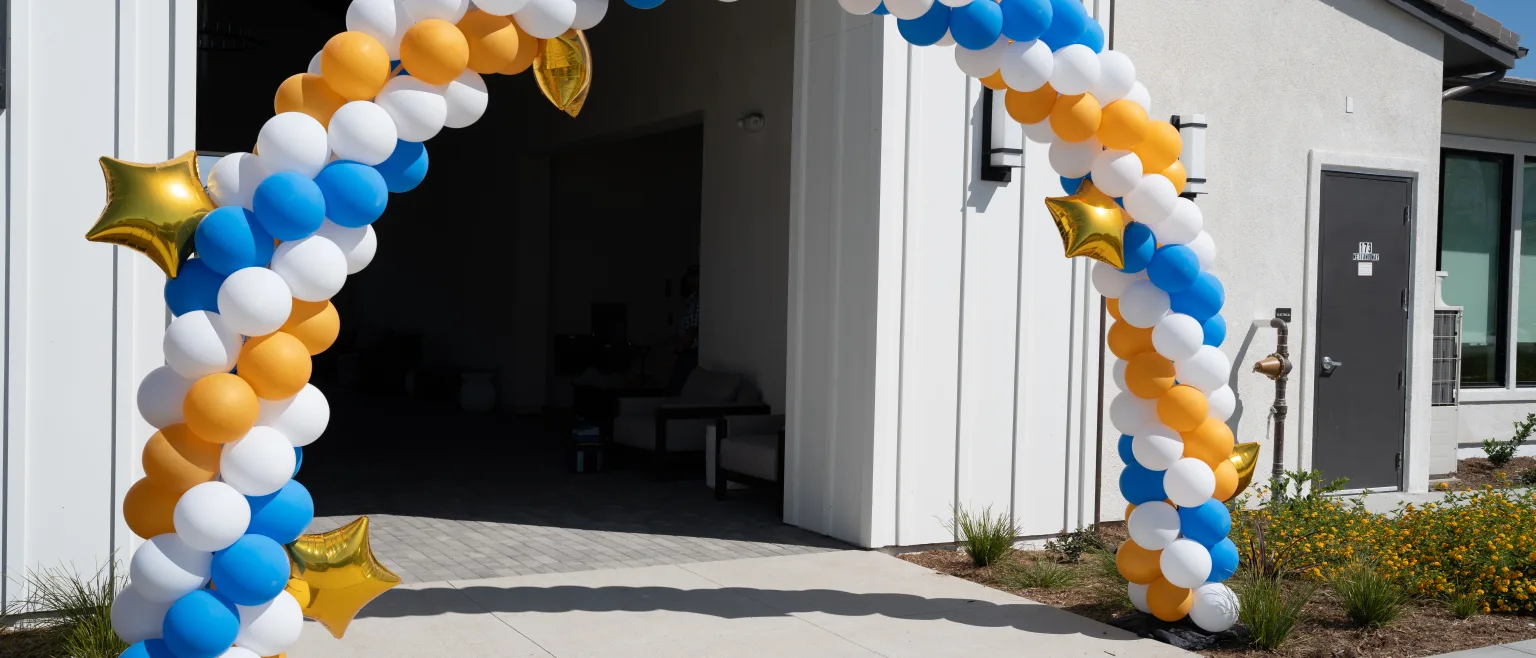
Ground-level columns at the community entrance and at the sales office door. These do not attract anyone. They confirm arrival and mark the threshold, and they are what appears in the photographs your marketing team takes.
Sizing a route
Four measurements size a system. You can take them yourself before you call us, or send the site plan and we will take them off that.
- Frontage length. How much arterial road runs past the community. Long frontage means more approach time and a longer window in which the anchor is working.
- Turn count. Every turn between the arterial and the sales office. A single turn is a Model Marker problem. Three or more turns through an active construction site is a Full Navigation System problem.
- Decision points. Not the same as turns. A decision point is anywhere a driver could plausibly go wrong — an unmarked fork, a construction detour, a second entrance that leads to the wrong phase.
- Sight lines. What blocks the view, and from where. Sound walls, mature landscaping, a grade change, a row of parked trucks on delivery day.
The count follows from those four, not from a package. A short frontage with four decision points needs more markers than a long frontage with one.
Where a marker earns its position
There is one test, and it is done on foot. Stand at each marker and look forward along the route. If you cannot see the next one, the gap is too big and a driver will lose the thread there. If you can see two ahead comfortably, you have one more than you need and the middle one is not earning its place.
That test settles most placement arguments before they start. What it also settles is where not to spend: a long straight run with no turn and no fork does not need breadcrumbs. Nobody gets lost on a straight road. Markers belong at decisions.
Symmetry is the most common way to overspend on a route. A route is read from a moving car in one direction. Lining both sides of the street looks considered on a site plan and buys nothing on the approach.
Budget priority, and what to cut first
When a route has to come down in price, it comes down in this order.
- Cut breadcrumbs on straight runs. The cheapest reduction with the least cost to the system.
- Cut the second side of the street. See above.
- Reduce entrance markers. They photograph well and they confirm arrival, but a driver at the door has already arrived.
- Keep the marker at the final turn. The last decision before the destination is the one that loses people.
- Keep the anchor. It is the only element that recruits anyone. Everything else converts traffic the anchor has already produced.
The three configurations follow that logic. Model Marker is one model or a soft opening: the anchor and a minimum path, two of the four bands. Guided Route adds route anchors and the decision-point breadcrumbs, and covers three. Full Navigation System is entrance-to-model coverage — entrance columns, full path, route anchors and the anchor itself, all four.
Every configuration is a starting point sized to the actual site. Installation and strike are quoted with the job and scale with distance from our workshop.
None of the three is a fixed bundle. Components are added or removed to match what the frontage actually needs, and a route that sits between two tiers — or outside all three — is priced the same way. The names exist so there is something to quote from. If your site needs two more decision-point markers and one less entrance column, that is the quote you get.
Endurance — air, helium, heat and wind
The material decision is made by how long the route has to hold, not by what it costs.
Air-filled work on frames — columns and structured clusters — holds for days and does not care about temperature the way a floating element does. It cannot fly, so it does the ground and eye-level work. Helium buys altitude and nothing else, and it is the part of the system that degrades first. That trade is the whole reason the tiers exist.
Inland Empire summer is the hard case. Direct sun degrades latex, and a route that looks correct at 8:00 AM can be visibly tired by mid-afternoon on a 100-degree Saturday. For multi-day exposure we build with high-endurance components rather than replacing standard ones twice.
Wind is the same story from the other side. Motion is the asset — it is what takes a driver’s attention — and it is also the load the anchoring has to carry. Secure anchoring and professional-grade infrastructure are not upsells here; they are what keeps a system in place through an afternoon of it.
Near airports we fly shorter, or we do not fly the anchor at all. That is an operational judgment we make from the site and the forecast, and it is better made in the quote than on the morning of your opening.
For activations that run more than one day, a route refresh is available and priced separately to the route. It is never included in an install, because it is real crew time on a real return trip.

Install and strike windows
There is no standard start time, and a vendor who quotes you one is quoting a habit rather than a plan.
The fixed point is the finish, not the start. Structural completion is contracted in writing, before your doors open, and the install is worked backwards from there: route length, component count, how much of it has to be filled on site, crew size and travel. On a Model Marker that can put the crew on site a few hours before dawn.
Why we build before anyone arrives is a simpler question. A route runs along public road, parking and walkways, and building it means crews, ladders and helium cylinders occupying those surfaces for hours. Before the site opens there is no traffic to work around, no visitors, no sales staff and no deliveries. By 7:00 AM there is all four. The anchor in particular has to be filled on site — it cannot be transported inflated — and that is not work to be doing while your first family is parking.
That completion time is the one thing we guarantee, and it is the claim we would rather be held to than any other. It is also why we do not promise an arrival time: the arrival is whatever the schedule requires, and the finish is what you are actually buying.
Strike is scheduled the same way: full teardown, hardware recovery, site left as found. Nothing stays behind for your team to deal with on Monday.
On lead time — for model openings and route work we usually hold the stock, so we can often take a booking the day before. Larger installations needing special-order items or a site plan need at least a week.
What we need from you to build the plan
If you have these seven answers, we can build a route plan and a price without a discovery call. If you do not have all of them, send what you have — the first four are enough to start.
- The opening date and the event start time. The start time is what the completion promise is measured against.
- The site address, and which arterial the approach comes from.
- How many turns from that arterial to the sales office.
- Your brand colors. The closest available balloon color is named on your quote.
- One day or several. This drives whether we build in high-endurance components and whether a refresh belongs in the quote.
- Any site access or safety requirements. Tell us on the request and they are built into the install plan.
- Whether you are near an airport. It changes what we can fly.
Send the opening date and the site address.
You’ll get a routed scope and a price back. Send your brand colors and the quote names the closest available balloon colors.